> For the complete documentation index, see [llms.txt](https://docs.inhousequeue.xyz/docs/llms.txt). Markdown versions of documentation pages are available by appending `.md` to page URLs; this page is available as [Markdown](https://docs.inhousequeue.xyz/docs/commands/maps-commands.md).
# Map commands
Commands for managing Maps.
#### :crown: **Admin only commands**
#### :bulb: **General command for everyone**
**Required** parameters will be in \[Square brackets]
**Optional** parameters will be in (Curly brackets)
## :crown: Set Maps
If your competitive game features multiple maps (e.g., Valorant, Call of Duty, Rainbow Six Siege), consider incorporating these into your InHouseQueue server configuration. You can add maps individually, including the map name, game mode (if applicable), and an image URL for the map.
When enabling maps, you choose a **map selection mode** that determines how a map is picked each game. See [Map Selection](/docs/features/map-selection.md) for a detailed breakdown of each mode.
```
/maps enable [map_selection] [game]
/maps disable [game]
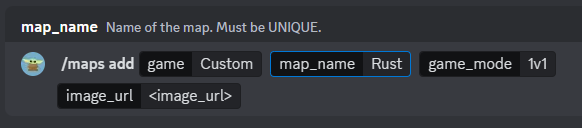
/maps add [game] [map_name] (game_mode) (image_url)
/maps remove [map_name]
/list_maps
```
`/maps enable` - Enable maps for your selected game and choose a selection mode: **Random**, **Map Vote**, or **Map Ban**.
`/maps disable` - Disables maps. Maps will no longer be sent.
`/maps add` - Add a map to your server pool.
`/maps remove` - Remove a map from your server pool.
`/list_maps` - List all maps available on your server.
### Map Selection Modes
When running `/maps enable`, you will be asked to choose a selection mode:
| Mode | Description |
| ------------ | ---------------------------------------------------------------------------------------- |
| **Random** | A random map from your pool is automatically selected when a game begins. |
| **Map Vote** | All players in the match vote for their preferred map. The map with the most votes wins. |
| **Map Ban** | Team representatives take turns banning maps until one remains. |
For a full explanation of how voting and banning work, see the [Map Selection](/docs/features/map-selection.md) feature page.
### How it works:
1. First, enable maps, choose a selection mode, and select the game you'd like to allow it for.
2. Add a map. Fill in all the relevant fields. Adding an image URL is recommended! You can use sites such as IMGUR to host images. You can reuse the instructions [here](/docs/premium/premium-commands/tier-1.md#update-banner) to learn how to generate a URL for your image.
3. Add more maps! Repeat the processes until you have your desired number of maps
4. That's it! When a game begins, the map selection process kicks in based on the mode you chose. For **Random**, a map is picked automatically. For **Map Vote** and **Map Ban**, a temporary channel is created where players can participate before the game lobby is set up.
5. Anyone on the server can run `/list_maps` maps. All other map commands can only be run by Admins, or discord roles that have been [granted ](/docs/commands/server-commands.md#grant-admin-commands-to-moderators-helpers)permissions.
6. For a step by step on how Voting and Banning Maps works check out [Map Selection](/docs/features/map-selection.md)